This article contains affiliate links. We may earn commission on signups at no additional cost to you.
Blackjack Basic Strategy: When to Hit, Stand, Double, Split
Basic strategy isn't a secret. It's a chart, and it's the closest thing to a free edge a casino will ever let you have. Here's how to memorize it, when it cracks, and what it's actually worth.
The reason every honest gambling writer keeps coming back to blackjack is mathematical, not romantic. Of every game on the floor. Physical or online. Blackjack offers the lowest house edge for a player who knows what they're doing. And unlike poker, the "knowing what you're doing" part is fully solved. It's a chart. You memorize the chart. You play the chart. That's basic strategy.
Most people don't. Most people hit when they should stand, stand when they should hit, refuse to split aces because they "feel" wrong, and refuse to double down on 11 because they don't want to "risk more." Every one of those decisions costs them money over time. Not a lot per hand. But a lot per night, and a lot per year.
This guide is the no-frills version. We'll cover what basic strategy is, the moves people get wrong, what edge it actually buys you, and the variations you'll see in real online casinos that change the math at the margins.
What basic strategy is, mathematically
Basic strategy is the set of moves. Hit, stand, double, split, surrender. That, for any combination of your hand and the dealer's upcard, produces the highest expected value over millions of hands. It was first computed by hand in the 1950s by four US Army mathematicians (the "Four Horsemen"). It has been recomputed by every gambling researcher since. The answers don't change. The chart is the chart.
The point is that it removes intuition from the equation. Your gut tells you to stand on a 16 against a dealer's 10 because hitting "feels like a bust." Your gut is wrong. The math says: hit. Even though you'll bust more often than not, the alternative. Standing. Loses even more frequently. The least-bad move is the one that wins.
What it actually looks like at the table
The screenshots below are from a real session at Rooli. The kind of marginal-looking hand basic strategy talks about. The dealer is showing a 9. The player is dealt a 9 and a 5: total 14. Almost everyone's instinct is to stand. The chart says hit.
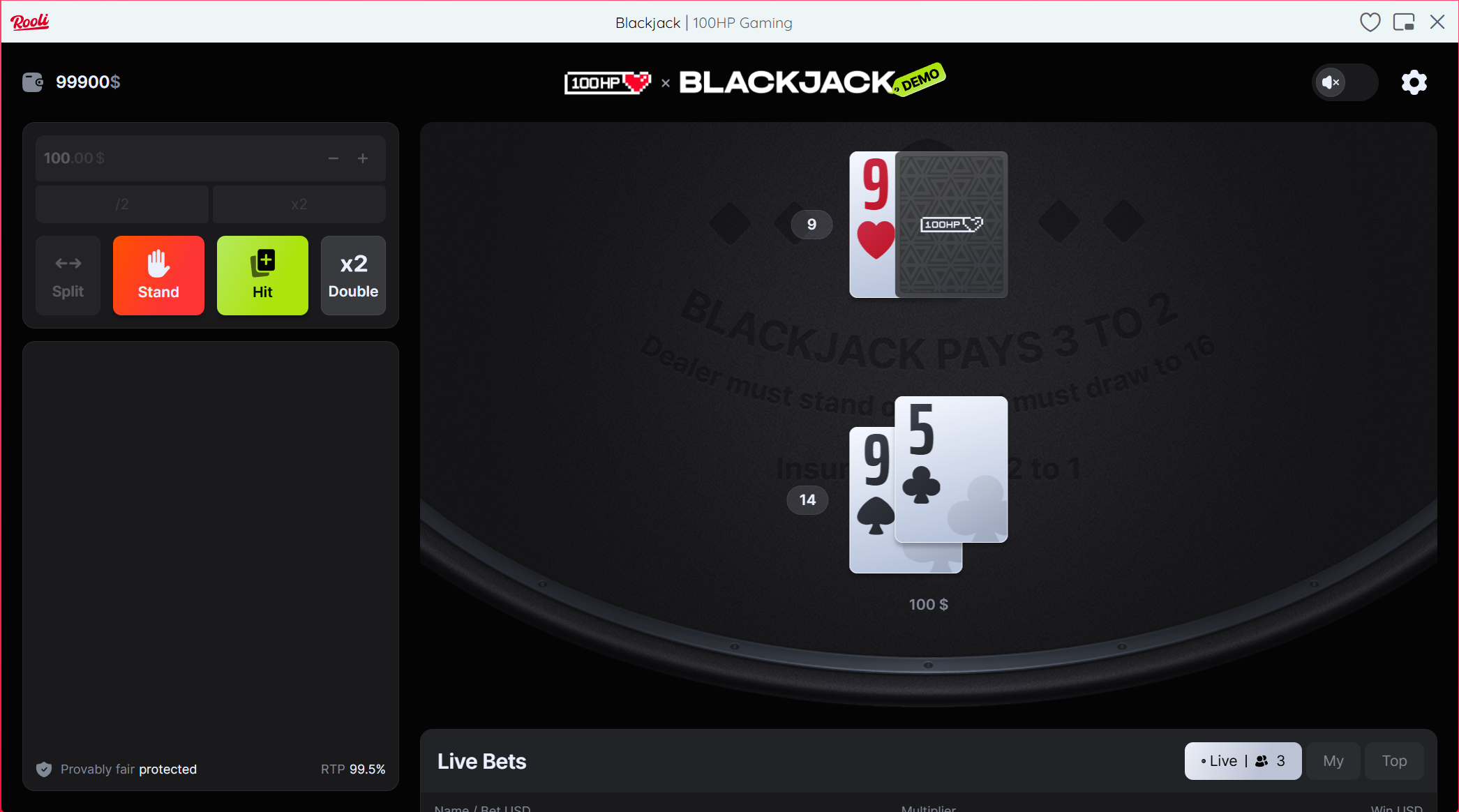
Hand 1: dealer shows 9, player holds 14. Standing here loses on average; the chart says hit. (Rooli, May 2026.)
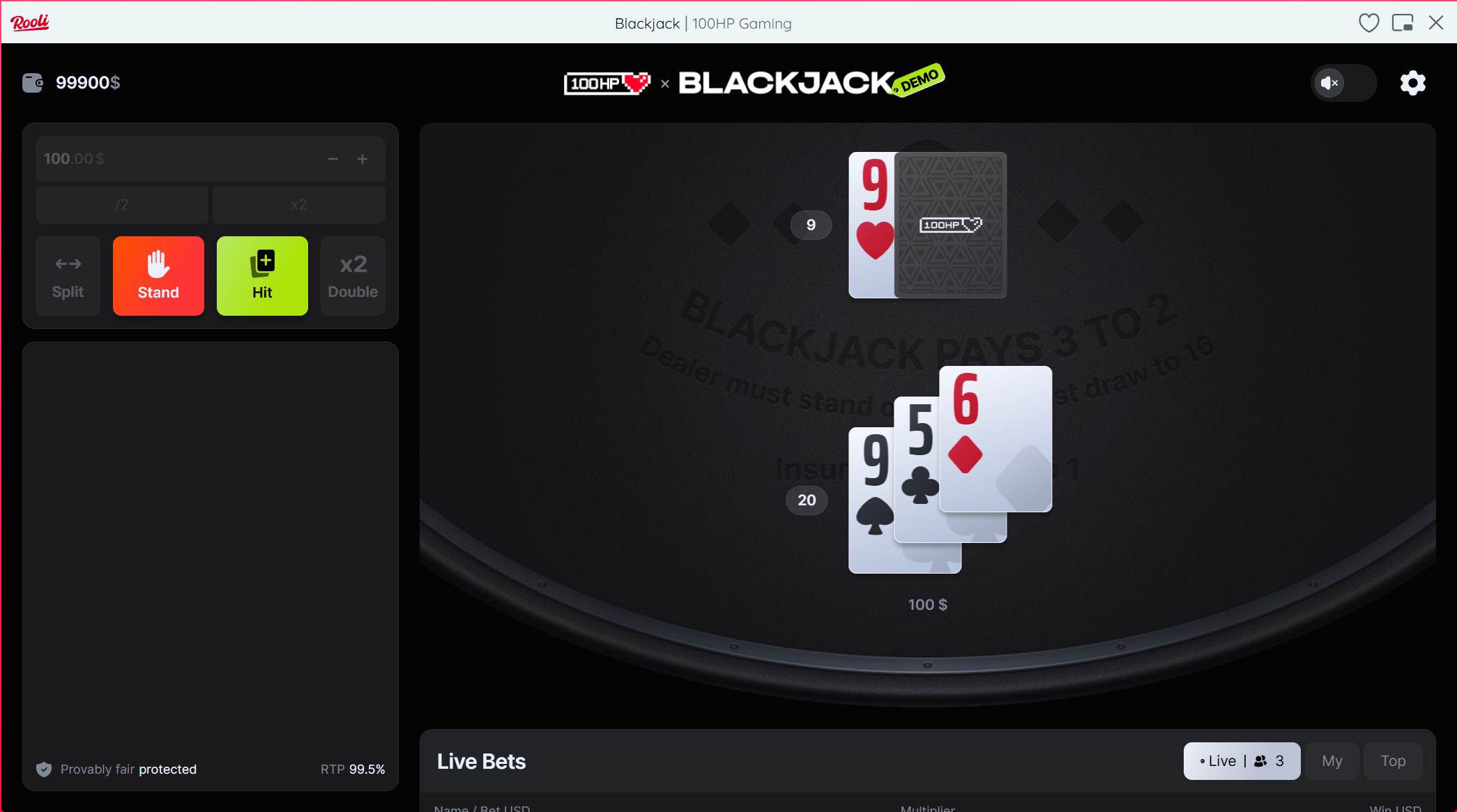
Hand 2: the hit. Drew a 6 for 20 total. That's the math working. Not luck, just the play with the higher expected value.
It worked this hand. It won't every hand. But over a thousand hands of 14 vs 9, hitting outperforms standing by a meaningful margin. And the chart is the only way to play that meaningful margin consistently.
The five moves people get wrong most often
In ten years of watching casual players, these are the recurring mistakes that bleed bankrolls. At home games, in physical casinos, and at live-dealer tables online.
1. Standing on a soft 18 against a dealer's 9, 10, or ace
Soft 18 (ace–seven) is the most-misplayed hand in blackjack. Players see "18" and stand reflexively. But against a dealer's 9, 10, or ace, your 18 is a losing hand on average. You need to hit and try to improve. The ace gives you a free shot at making it stronger without busting. Take it.
2. Refusing to split eights against a dealer's 10
This is the most psychologically painful correct play. You have 16, the dealer has a 10 showing, and you're being asked to put more money in the pot. The math says: do it. Two hands of 8 give you a much better chance of beating the dealer than one hand of 16, and the difference is worth roughly 4–5% of your wager.
3. Standing on 12 against a dealer's 2 or 3
Same family of error. Players see 12 as "safe" and stand. The math says hit against 2 and 3. The dealer's bust probability with those upcards isn't high enough to justify the conservative play.
4. Not doubling down on 11
Beginners under-double. The math is straightforward: 11 against any dealer upcard except ace is a doubling situation in most rule-sets. You'll win the doubled bet more often than you'll lose it, and that small edge compounds.
5. Taking insurance
Don't. Ever. Insurance is a side bet on the dealer having blackjack. It has a house edge of roughly 7%, which is one of the worst bets in the casino. The only time it's even close to fair is when you're counting cards. And if you're counting cards, you're already not reading this article.
What the edge actually buys you
Played perfectly with average rules (six-deck shoe, dealer stands on soft 17, double after split allowed, no surrender), basic strategy gets the house edge down to about 0.5%. That's a remarkable number.
To put 0.5% in context: if you bet £10 per hand and play 60 hands per hour for four hours, you'd wager £2,400. The expected loss at that house edge is £12. The same play at slots with a 4% house edge would cost £96 in expected value. At a 5.26% house roulette game, £126.
That's not "winning." Nobody is promising you'll win. But it is the difference between gambling as entertainment and gambling as a steady transfer of your money to the operator.
Editor's pick · play it now
Claim the 200% up to €5,000 + 200 FS at Rooli.
Industry-leading 200% match on your first deposit up to €5,000, plus 200 free spins. Fast crypto cashouts and the full game library covered in this guide.
18+. T&Cs apply. Play responsibly.
Rule variations that change the math
Not all blackjack tables are equal. Look for these rules. They shift the edge for or against you by tenths of a percent that add up.
| Rule | Effect on house edge |
|---|---|
| Single deck | Player favourable (-0.48%) |
| Double-deck | Player favourable (-0.19%) |
| Six or eight decks | Standard |
| Dealer hits soft 17 (H17) | House favourable (+0.20%) |
| Dealer stands soft 17 (S17) | Player favourable |
| Double after split allowed (DAS) | Player favourable (-0.14%) |
| Resplit aces allowed | Player favourable (-0.08%) |
| Late surrender available | Player favourable (-0.07%) |
| Blackjack pays 6:5 instead of 3:2 | House favourable (+1.40%). Avoid |
The last row is the most important. If you ever see a table. Especially in a live-dealer studio. Paying 6:5 on a natural blackjack, walk away. The 1.4% edge swing wipes out everything basic strategy bought you. It's the casino's most common quiet tax.
Where basic strategy stops working
Three places.
Counting cards. Once you're tracking the deck, basic strategy is a baseline you deviate from based on the count. Hi-Lo is the canonical system; in a heavy positive count, you stand on 16 against a 10 that you'd otherwise hit, take insurance, and so on. Card counting is impossible against online RNG blackjack (the deck shuffles every hand) and impractical against live-dealer streams (the studios use continuous shuffle machines or shuffle frequently enough to neutralize it).
Side bets. Perfect Pairs, 21+3, Buster Blackjack. Every side bet at the table carries a house edge of 4–10%. Basic strategy doesn't address them because the answer is always the same: don't make them.
Tournament play. Tournament blackjack rewards risk-taking in specific situations (you need to overtake the leader on the last hand) that the chart doesn't model. Different game, different math.
How to memorize the chart
Three approaches that actually work.
Print it and keep it next to you. Online casinos don't care. Live-dealer dealers don't care. Physical casinos generally don't care either, though they'll think less of you for it. Just look at the chart. After fifty hands you'll have most of it. After two hundred, all of it.
Use a free trainer. Apps like Blackjack Trainer (web and mobile) drill you on random hands and flag every mistake. Twenty minutes a day for a week and the chart is in muscle memory.
Learn the patterns, not the squares. Basic strategy isn't 350 independent decisions. It's about a dozen patterns. "Double on 11 always." "Split eights always." "Stand on 17+ always." "Hit soft 17 or below always." Once you see the shape, you don't need to memorize individual cells.
Where to actually play this
The flat answer: at the online casino with the best rules and the lowest minimums while you're learning. We've reviewed Rooli extensively. Their blackjack tables run S17, DAS, with a 3:2 payout on naturals at the £1 minimum tables. That's a player-favourable rule set at stakes low enough to learn without bleeding money.
We'll keep flagging when their rules change. They have done in the past, and they will again.
Editor's pick · play it now
Claim the 200% up to €5,000 + 200 FS at Rooli.
Industry-leading 200% match on your first deposit up to €5,000, plus 200 free spins. Fast crypto cashouts and the full game library covered in this guide.
18+. T&Cs apply. Play responsibly.
FAQ
Frequently asked questions
Does basic strategy guarantee I win?
Is basic strategy different for online blackjack vs. Live dealer?
Can I use a basic strategy card at an online casino?
Should I learn basic strategy before card counting?
What is the worst blackjack rule I should avoid?
The Verdict
4.7The single highest-EV decision any casual casino player can make. Learn it before you sit down. Not after.
Editor's pick · play it now
Claim the 200% up to €5,000 + 200 FS at Rooli.
Industry-leading 200% match on your first deposit up to €5,000, plus 200 free spins. Fast crypto cashouts and the full game library covered in this guide.
18+. T&Cs apply. Play responsibly.
Keep reading
Related strategies
 General4.9
Casino Bankroll Management: The Only Rule That Actually Works
Most casino guides bury the bankroll discussion under "strategies." It's the other way around. Bankroll is the strategy, and every other tactic is window dressing. Here's the framework.
Live Dealer4.3Live Dealer vs RNG: Which Games Give Better Odds?
Live dealer feels more "real" than software-driven table games. But does it actually pay better? We compared the house edges, the speed, and the variance over a year of play at Rooli.